News|Videos|March 16, 2026

Detecting, Identifying, and Analyzing Body Fluids Using Raman Spectroscopy

In this interview clip, Igor Lednev, a Distinguished Professor and Williams-Raycheff Endowed Professor at the University at Albany, State University of New York, talks about the progress made by SupreMEtric LLC, a startup that originated from research at the University at Albany.

SupreMEtric LLC is a startup company that originated from research at the University at Albany that focuses on modernizing forensic science. The company utilizes laser spectroscopy and complex statistical modeling to create a non-invasive way to identify biological fluids at crime scenes.1 Their primary objective is to offer law enforcement and forensic laboratories a universal, rapid tool for analyzing evidence without damaging the samples.1 Significant financial backing for this innovation has come from the National Science Foundation and the Department of Justice, including nearly $1.3 million in recent federal grants.1 These resources are currently being used to transition their patented technology from a laboratory setting into a commercially available product for criminal justice professionals.1 Through these partnerships, SupreMEtric LLC’s main objective is to improve the accuracy and efficiency of forensic investigations.

Igor Lednev, a Distinguished Professor and Williams-Raycheff Endowed Professor at the University at Albany, is the Founder and CTO of SupreMEtric LLC. At Pittcon 2026, which took place in San Antonio, Texas, Lednev updated us on the latest progress made by SupreMEtric LLC in applying Raman spectroscopy for the detection, identification and analysis of all main body fluids.


At Pittcon, Lednev delivered a talk titled, “Raman Spectroscopy and Machine Learning for Forensic Purposes Biomedical Applications.” Part 1 of our interview with Lednev focused on his talk, which was part of the Pittsburgh Spectroscopy Award symposium at Pittcon honoring his receiving of the award for 2026.2 We also discussed the application of advanced statistics in forensic analysis, focusing most of our conversation on the development of software for Raman spectroscopic data analysis.3

Spectroscopy will be continuing to provide coverage of the Pittcon 2026 conference on an ongoing basis as we report back from San Antonio. You can stay up to date with our coverage of the Pittcon 2026 conference here.

References

  1. SupreMEtric LLC, Homepage. Supermetric.com. Available at: https://www.supremetric.com/ (accessed 2026-03-13).
  2. Lednev, I.; Wetzel, W. How Are Raman Spectroscopy and Machine Learning Advancing Forensic and Biomedical Applications? Spectroscopy. Available at: https://www.spectroscopyonline.com/view/how-are-raman-spectroscopy-and-machine-learning-advancing-forensic-and-biomedical-applications- (accessed 2026-03-13)
  3. Lednev, I.; Wetzel, W. Integrating Chemometrics with Raman Spectroscopy in Forensics. Spectroscopy. Available at: https://www.spectroscopyonline.com/view/integrating-chemometrics-with-raman-spectroscopy-in-forensics (accessed 2026-03-13).

Related to this article

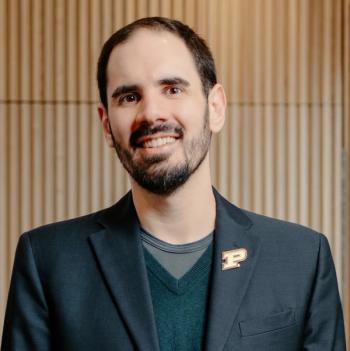
Brandon E. Boor is the Dr. Margery E. Hoffman Associate Professor in the Lyles School of Civil and Construction Engineering at Purdue University. | Photo Credit: © Brandon Boor.
In the second part of our interview with Brandon Boor of Purdue University, he discusses how his team controls experimental variables during cleaning experiments in order to obtain interpretable data.
Sizing Up the Nanoscale: Measuring Nanocluster Aerosol in Indoor Air
In the first part of a multi-part Q&A, Brandon Boor, the Dr. Margery E. Hoffman Associate Professor in the Lyles School of Civil and Construction Engineering at Purdue University, describes the instrumentation and methodology behind measuring nanoparticle size distributions at the nanocluster scale (1–3 nm) and outlines the technical challenges of acquiring reliable, real-time data at these dimensions.
The Society for Applied Spectroscopy Logo 2026
The Peter Griffiths Award, named for the legendary infrared spectroscopist, recognizes the best paper published annually in Applied Spectroscopy Practica. Its inaugural recipients, Sara Fraser-Miller and coauthors, will be honored at SciX 2026, and the journal is now accepting 2026 submissions for the third award.
The 2026 Emerging Leader in Molecular Spectroscopy Award
Jay P. Kitt, a University of Utah research assistant professor who has spent a decade extending confocal Raman microscopy from phospholipid membranes to nucleic acids and peptide-membrane interactions, is the recipient of Spectroscopy's 2026 Emerging Leader in Molecular Spectroscopy Award.